APOM Authenticate™ · Now available

Opposing counsel has screenshots. Are they fabricated?

The evidence pipeline your firm has been improvising. Systematized.

Screen opposing evidence for fabrication before you walk into the courtroom. Send preservation letters before retention windows close. File subpoenas that get accepted the first time. Every file hashed, timestamped, and documented with chain of custody.

Start your free trial See how it works →

Plans from $249/month. Seven-day free trial on Tier 1 and Tier 2.

Watch the 2-minute demo
Built for Family law attorneys Minor's counsel Paralegals Solo practitioners Mid-size firms Civil & IP litigators
How it works

Screen•Preserve•Subpoena

1

Screen opposing evidence

Upload what the other side produced. The scanner reads what the file carries internally and flags signs it was altered, before you're in front of the judge.

2

Preserve before it's gone

Login records at some custodians are kept for weeks, not months. Generate the preservation letter at intake, not in week six, and have your client download her own data the same day.

3

Subpoena without rejection

Pre-filled templates built to clear the reasons platforms reject subpoenas: wrong address, "any and all" language, missing domestication, wrong format.

Inside the platform

Every tool your case needs, in one digital evidence suite.

Fabrication Detection

Files remember what was done to them. The scanner checks for metadata inconsistencies, timestamp anomalies, compression artifacts, editing software fingerprints, and font irregularities in documents.

Each scan produces a court-ready screening report: plain-language findings, severity flags, SHA-256 hash, and chain of custody documentation. Print and file.
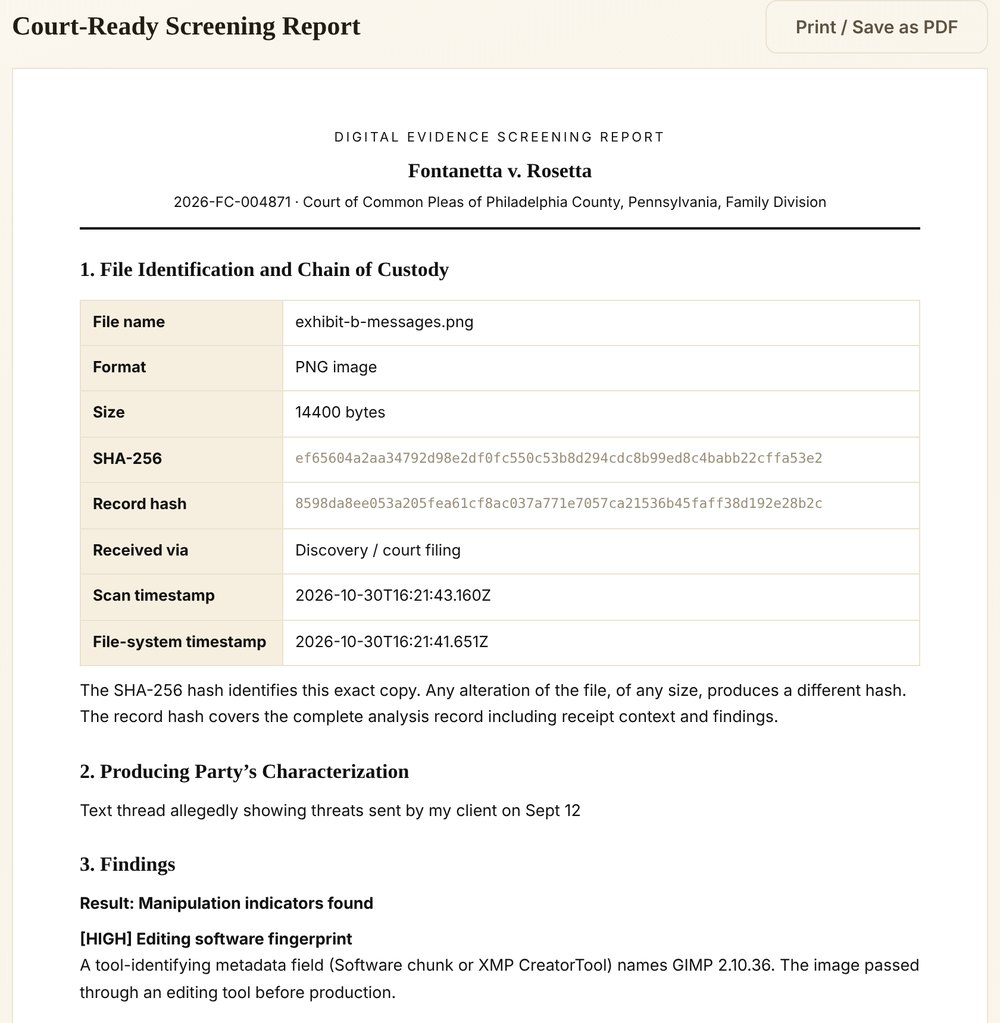
APOM Authenticate court-ready findings report for Smith v. Smith with file identification, chain of custody hashes, and findings
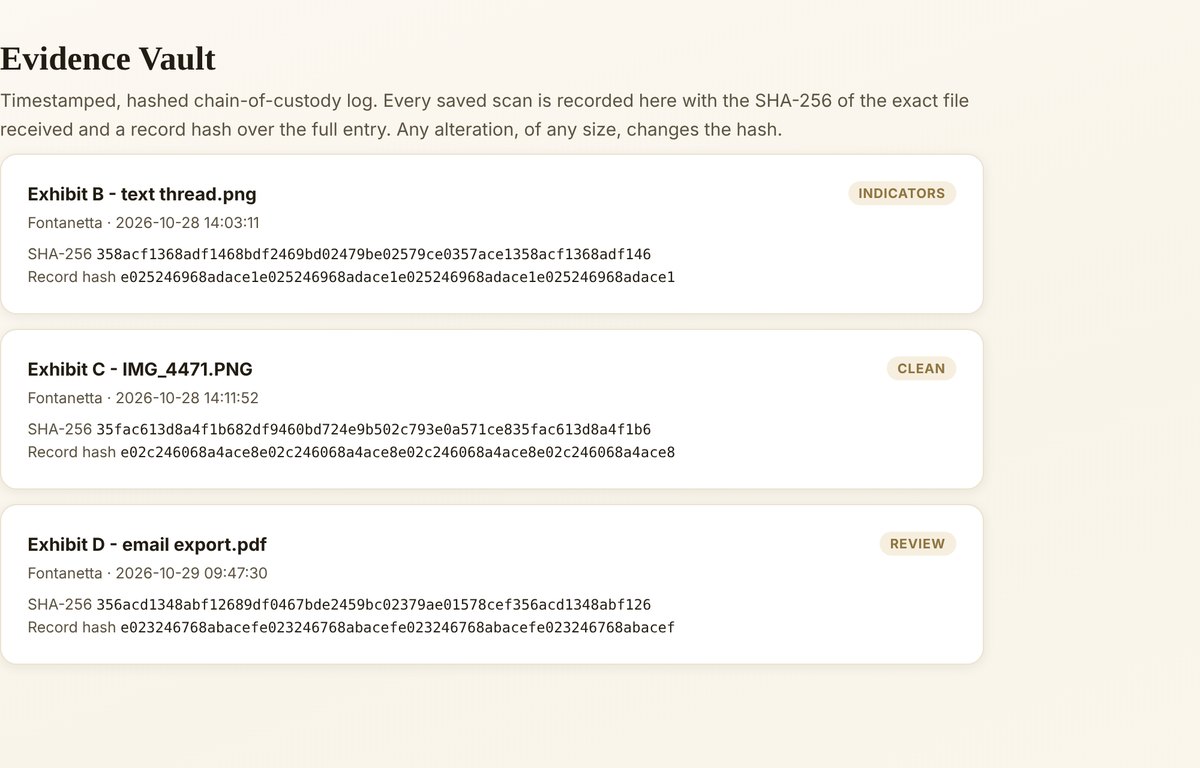
Evidence Vault entryAPOM Authenticate evidence vault entry with case, receipt details, SHA-256 file hash and record hash

Hashed Evidence Vault

The hashed log is what makes a finding hold up. Every entry carries a SHA-256 hash of the exact file received and a record hash covering the full analysis: how it was produced to you, what the producing party claims it shows, the findings, and the timestamps. Any alteration, of any size, changes the hash.

Preservation Letters & Subpoena Templates

The preservation letter generator pre-fills your case details, the platform's correct legal process address, and the specific items your scans flagged.

Expedited subpoena templates for Apple, Google, Microsoft, Meta, Intuit, Verizon, AT&T, T-Mobile, TracFone, and Amazon/Blink, with the Motion for Expedited Production, domestication petition, and Shield Law attestation included. Every field is editable before you copy or print.
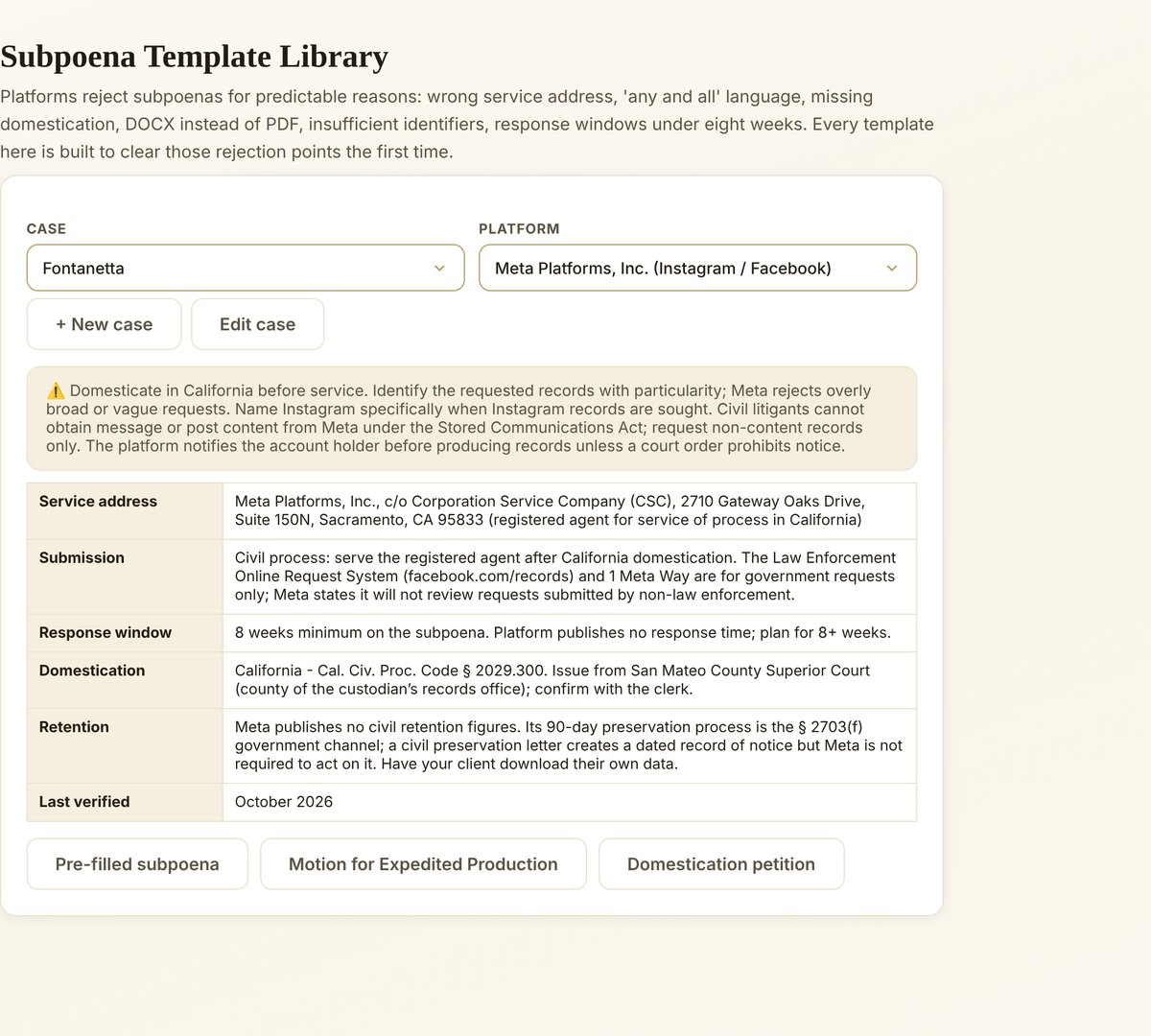
APOM Authenticate subpoena template library showing Meta service address, submission rules, domestication and retention windows
Standards

Built to the authentication rules courts apply.

Reports and records are structured around the authentication requirements for electronic evidence in California and federal court.

Cal. Evid. Code §§1400–1402
Authentication of writings, including electronic records and messages
Cal. Evid. Code §1552
The presumption of accuracy for computer printouts, and what it takes to rebut it
FRE 901(b)(9)
Documented process or system producing an accurate result, with hash verification
FRE 902(13)–(14)
Machine-generated records and data copied from devices, certified by hash
Privacy & data handling

Opposing evidence stays in your hands.

Every scan runs locally. The file is hashed at intake, and the analysis becomes part of that case's chain of custody, which runs per case from intake forward.

Scans run locally
Fabrication screening happens on your machine. The file itself isn't sent anywhere to be analyzed.
Hashed at intake
A SHA-256 hash of the exact file received, plus a record hash over the full analysis, so any change is detectable.
Work product, by design
Platinum case reviews run under attorney supervision and are structured as attorney work product.
Pricing

Plans start at $249/month.

Introductory pricing; one account per firm. Every plan includes the timestamped, hashed evidence log with full chain of custody.

Tier 1

Fabrication Detection

$249 /month

Scanner, court-ready screening reports, and the hashed evidence vault.

Tier 2 · Most firms

Detection + Templates

$599 /month

Everything in Tier 1, plus preservation letters and the subpoena library: ten custodians, domestication petitions, Shield Law attestations and the Motion for Expedited Production.

Tier 3 · Firm

Firm

$1,299 /month

Everything in Tier 2, plus priority onboarding and a direct escalation path into APOM Investigations for crypto tracing, subject investigations and device forensics, quoted per case.

Platinum

Platform + 1:1 Case Review

$2,499 /month

Everything in Tier 3, plus a monthly one-hour case review with Kyērstin O’Neal.

Start your 7-day free trial
When a scan finds something

Escalate straight to APOM Investigations.

Some cases need signed forensic work: crypto asset tracing, subject investigations, device forensics. Bring the screening report and the hashes. The chain of custody your scans established carries directly into the investigation, quoted per case.

About APOM Investigations →
Who built it

Built by the investigator attorneys call when the evidence is digital.

Kyērstin O’Neal
Digital forensics investigator and founder, APOM Research
M.S. Cybersecurity Candidate, Georgetown University
Former Cybersecurity and Infrastructure Security Agency (CISA)
Former Sandia National Laboratories
CompTIA CySA+, Security+, Network+, CSAP, CIOS, CSIS

APOM Research is not affiliated with, endorsed by, or representing any government entity.
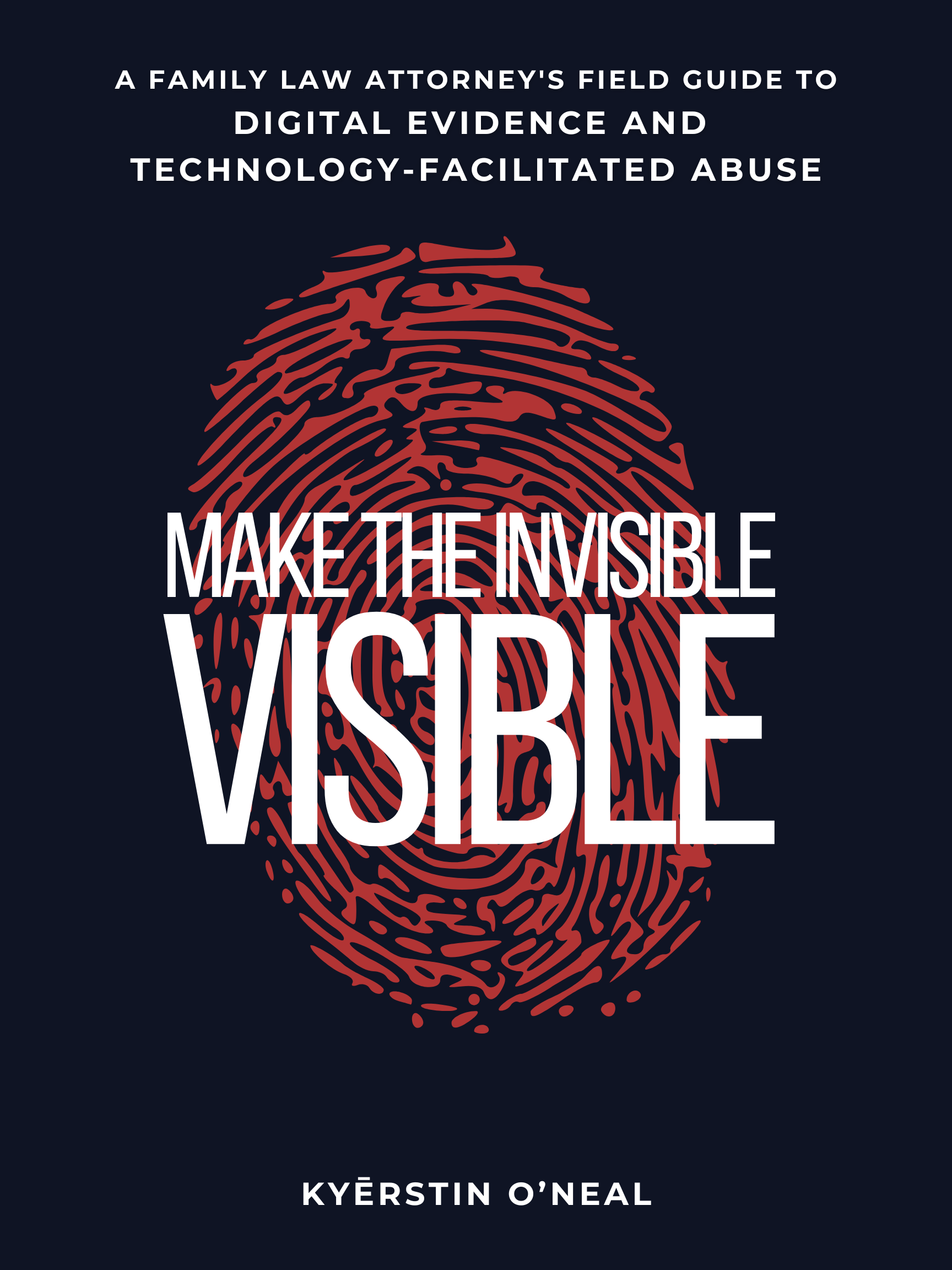
Make the Invisible Visible book cover
The book

Make the Invisible Visible

A Family Law Attorney's Field Guide to Digital Evidence and Technology-Facilitated Abuse.

Get it on Amazon →
★★★★★

“I worried that law enforcement would dismiss me or minimize the danger because the abuse was happening online, across multiple platforms, and through a network that felt impossible to track or describe. Working with Kyērstin O’Neal changed that. She moved quickly and methodically, identifying the people involved and mapping out the broader network in a way that finally made the full picture clear. She created a comprehensive and factual package that allowed me to approach the FBI and law enforcement with confidence, knowing I would be heard.”

Tina Swithin
Author & Advocate for Family Court Reform
Questions

What attorneys ask first.

Do I need a forensics background to use it?
No. It's built for attorneys and paralegals. Findings come back in plain language with severity flags, and every letter and template is pre-filled from your case and firm profile.
Does a scan prove evidence was fabricated?
A scan surfaces indicators and gives you the documented record to act on them: discovery requests, a preservation letter, a subpoena for the native original. When a case needs signed forensic findings, escalate to APOM Investigations.
Where are files processed?
On your own computer. Screenshots, PDFs and photos are analyzed in your browser and never uploaded to us. Each file is hashed at intake, and the hash and findings are recorded to that case's chain of custody.
Which platforms do the subpoena templates cover?
Apple, Google, Microsoft, Meta, Intuit, Verizon, AT&T, T-Mobile, TracFone, and Amazon/Blink, plus a Motion for Expedited Production, domestication petition, and Shield Law attestation.
Does Platinum require you to testify?
No. Case reviews are strategy time, run under attorney supervision and structured as attorney work product. Work that needs dedicated investigative scope is quoted separately through APOM Investigations.
Is there a free trial?
Yes. Tier 1 and Tier 2 start with a 7-day free trial. A card is required, nothing is charged until the trial ends, and you can cancel any time before then from Manage billing.
Data privacy

What we save, and why.

Do you save my evidence files?
No. Screenshots, PDFs and photos are analyzed in your browser and never leave your computer. The letters, subpoenas and evidence packages you generate are built there too, and we don't store them.
What data do you save, and why?
Only what makes your evidence hold up in court and saves you retyping:
  • Each file's fingerprint, size and the time it was logged. A SHA-256 hash is unique to the exact file. It lets you show that this exact file existed when you logged it and hasn't changed by a single byte since. It's the core of your chain of custody, and it reveals nothing about what the file shows.
  • Screening results. So your reports and evidence binder can be produced again whenever you need them.
  • Your Evidence Log entries: dates, descriptions and how each item was obtained. They become your exhibit index and chain-of-custody record automatically.
  • Case details: labels, party names, case numbers and courts. Every letter and subpoena caption fills itself, and your cases are there on any device and for colleagues. Client names are optional: a case label can be a file code or initials.
We hold this record, rather than your own computer, for a reason: a chain of custody is more credible when it's kept by someone other than the party relying on it.
Who can see my data?
Only your account. Every request is checked on our servers, so one account can't reach another's records. We don't access your case content except as you instruct, for example to answer a support request, and we never use it for advertising, profiling or training any model.
How is my data protected?
All traffic is encrypted, and data is held on Cloudflare's encrypted infrastructure. Passwords are stored as salted hashes, repeated failed sign-ins are locked out, and every APOM account with access to our systems uses multi-factor authentication. Evidence Log records are sealed when saved and never edited, so any change would be detectable.
Can firms outside the US use it?
Yes. Screening, the evidence vault and the Evidence Log work anywhere. Firms in Ireland and the EU get preservation requests addressed to each platform's EU data controller, and GDPR access requests for clients' own accounts. Our Data Processing Agreement, including the EU's Standard Contractual Clauses, governs how we handle case data.
Can I delete my data?
Yes. Export your records at any time as reports, spreadsheets and evidence packages, then email hello@apomarchives.com to delete specific records or your whole account, and we'll do it within 30 days. After cancellation, records are kept for 12 months so you can come back to them, unless you ask us to delete them sooner.

The details are in our Privacy Policy and Data Processing Agreement.

Walk in knowing what's been fabricated.

Seven-day free trial on Tier 1 and Tier 2. Card required, nothing charged until the trial ends, cancel anytime. Existing subscribers sign in here.

Start your free trial